On 5 and 6 July, the University of Barcelona will host a meeting of the European member institutions of the Higher Education Supporting Refugees in Europe (inHERE) project. Within the framework of inHERE, on 7 July, it will organize a multiplier event on good practices with other Spanish universities.
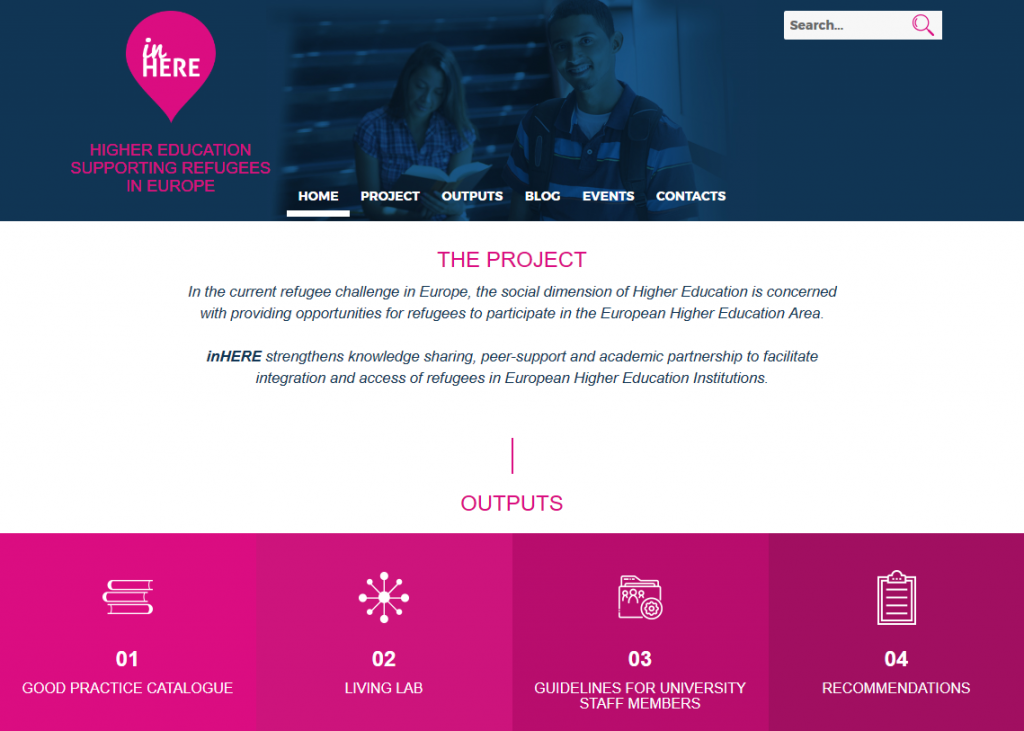 The University of Barcelona will host, on July 5 and 6, 2017, the second interim meeting of the European member institutions of the Higher Education Supporting Refugees in Europe (inHERE) project, whose main objective is to facilitate access and integration of refugees to European universities. To do this, the project seeks to improve the response to the specific needs of these people through the training of university staff and the exchange of good practices.
inHERE is co-funded by the Erasmus+ Programme of the European Union and coordinated by the Mediterranean Universities Union (UNIMED). In addition to the University of Barcelona and UNIMED, the partners of the project are the European Universities Association (EUA), La Sapienza University of Rome and Campus France. The United Nations High Commissioner for Refugees (UNHCR) is an associate member.
Within the framework of inHERE, the University of Barcelona is leading the activity Living Lab, in which staff members from different universities in Europe will design, explore, experience, refine and assess practices and policies applicable to real-life scenarios for evaluating their current or potential action plans to facilitate the access and integration of refugees to higher education.
At the Living Lab, there will be experiences included in the Refugees Welcome Map, made by the EUA, which has already collected more than 280 initiatives from 32 countries. Similarly, there will be experiences that arise from webinars and multiplier events, understood as exchanges of good practices between universities that carry out this type of intervention.
Precisely, the University of Barcelona will organize one of these multiplier events, on July 7 in the Ramón y Cajal classroom of the Historical Building of the University of Barcelona. “The role of universities in the refugee crisis” conference will present three examples of refugee reception actions carried out by universities in Spain. In addition, UNIMED will display the inHERE project and the EUA will announce the good practice catalogue of the Refugees Welcome Map.
inHERE is one of the projects that the University of Barcelona promotes within the framework of its Support program for refugees and people from conflict areas, coordinated by the UB Solidarity Foundation.