
SMILE presenta recomanacions polítiques per a una educació superior més inclusiva

En una taula rodona al Parlament Europeu, amb participació de Solidaritat UB, s’han debatut els 10 principis SMILE per a societats més diverses i inclusives.
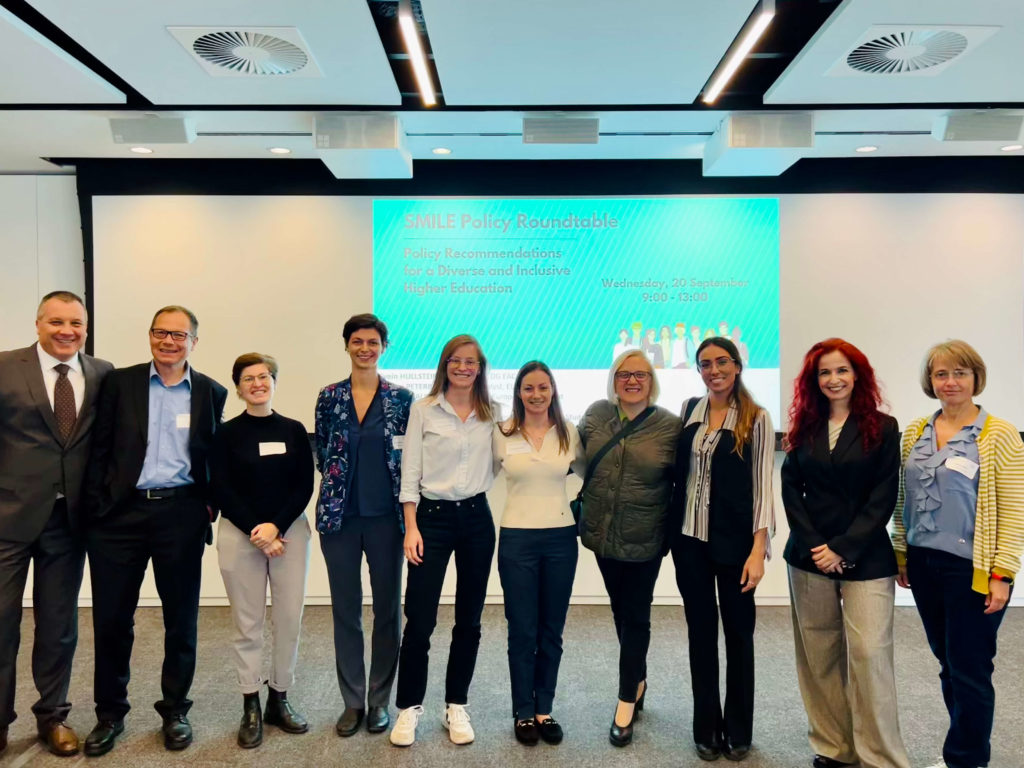
El projecte SMILE (Social Meaning Impact through LLL Universities in Europe), cofinançat pel programa Erasmus+, ha organitzat, el 20 de setembre de 2023 al Parlament Europeu, la taula rodona “Recomanacions polítiques per a una educació superior més inclusiva”, amb dues intervencions de la coordinadora del Programa UB Refugi, Cati Jerez.

SMILE ha desenvolupat un conjunt d’eines i cursos sobre diversitat i inclusió que poden ajudar els responsables polítics, les institucions d’educació superior i la societat civil a millorar l’estratègia d’implementació dels enfocaments d’inclusió i a fomentar la col·laboració en el futur.

En la taula rodona s’han presentat els recursos desenvolupats pel projecte; en especial, les Recomanacions Polítiques i Pla d’Acció, amb l’objectiu de generar debat sobre la seva idoneïtat i ús realista a Europa.

Recomanacions Polítiques i Pla d’Acció d’SMILE

Les Recomanacions Polítiques i Pla d’Acció d’SMILE identifiquen 10 punts, els principis SMILE, que es consideren crucials per crear societats més diverses i inclusives. Alguns d’aquests punts són transversals, com ara la necessitat d’aplicar un marc analític d’interseccionalitat en l’elaboració de polítiques d’inclusió i diversitat per garantir l’equitat en l’educació.

És a dir, en aquestes polítiques cal tenir en compte que els individus marginats sovint pertanyen a múltiples grups tradicionalment desfavorits i, com a resultat, són discriminats per diferents motius a diferents nivells. Per exemple, un estudiant d’origen migrant també pot tenir un estatus socioeconòmic baix i, si a més és una dona, pot trobar-se amb més dificultats a l’hora d’accedir i completar amb èxit els seus estudis.

D’altra banda, les recomanacions polítiques d’SMILE sostenen que, per facilitar la diversitat, cal:

  • habilitar itineraris flexibles en l’educació superior per a tothom;
  • oferir formació sobre diversitat i inclusió al personal, des de l’administració fins a la gestió;
  • identificar i utilitzar oportunitats de finançament orientades a la inclusió i la diversitat.

Com es va assenyalar durant la taula rodona, les plataformes d’educació superior consten d’una àmplia gamma de grups diversos, de manera que són un bon lloc per implementar estratègies d’inclusió.

Socis SMILE

La Fundació Solidaritat de la Universitat de Barcelona és una de les quatre organitzacions de la societat civil de Bèlgica i Espanya que participen en el projecte SMILE, juntament amb sis universitats europees d’Alemanya, Irlanda, Itàlia, Finlàndia, Malta i Romania. El projecte és coordinat per eucen (xarxa europea de formació universitària continuada).


Aquesta notícia té relació amb els següents ODS de l’Agenda 2030:

SMILE presents policy recommendations for a more inclusive higher education

In a round table at the European Parliament, with the participation of the UB Solidarity Foundation, the 10 SMILE principles for more diverse and inclusive societies were discussed.

The SMILE project (Social Meaning Impact through LLL Universities in Europe), co-funded by the Erasmus+ programme, has organized, on September 20 at the European Parliament, the round table “Policy recommendations for a diverse and inclusive higher education”, with two interventions by the coordinator of the UB Refuge Program, Cati Jerez.

SMILE has developed a set of tools and courses on diversity and inclusion that can help policy makers, higher education institutions and civil society to improve their strategy for a better and more suitable implementation of inclusion approaches and to encourage their collaboration in the future.

The round table has presented the resources developed by the project; in particular, the Policy Recommendations and Action Plan, with the aim of discussing their suitability and realistic use in Europe.

SMILE Policy Recommendations and Action Plan

The SMILE Policy Recommendations and Action Plan identify 10 points, the SMILE
Principles, that are crucial to creating more diverse and inclusive societies. Some of these points are transversal and cross-cutting in nature, such as the need to apply an intersectionality analytical framework to inclusion and diversity policymaking to ensure equity in education.

In other words, these policies must take into account that marginalized individuals often belong to multiple traditionally disadvantaged groups and, as a result, are discriminated against for different reasons at different levels. For example, a migrant background student may also have low socio-economic status and, if this student happens to be a woman, it may be an even bigger challenge for her to access and successfully complete her studies.

On the other hand, SMILE policy recommendations argue that, to facilitate diversity, it is necessary to:

  • enable flexible pathways in higher education for everyone;
  • offer staff training on diversity and inclusion at different levels, from administration to management;
  • identify and use inclusion and diversity-oriented funding opportunities.

As noted during the panel discussion, higher education platforms consist of a wide range of diverse groups, so they are a good place to implement inclusion strategies.

SMILE partners

The Solidarity Foundation of the University of Barcelona is one of the four civil society organisations from Belgium and Spain that participate in the SMILE project, together with six European universities from Germany, Ireland, Italy, Finland, Malta and Romania. The project is coordinated by eucen (European university continuing education network).


This news is related to the following SDG of 2030 Agenda: