Un seminari forma el professorat de secundària sobre “L’Holocaust com a punt de partida”

Adreçat a una quarantena de docents d’Espanya i Portugal, conclourà amb visites in situ per explorar la història de la comunitat jueva a Barcelona.
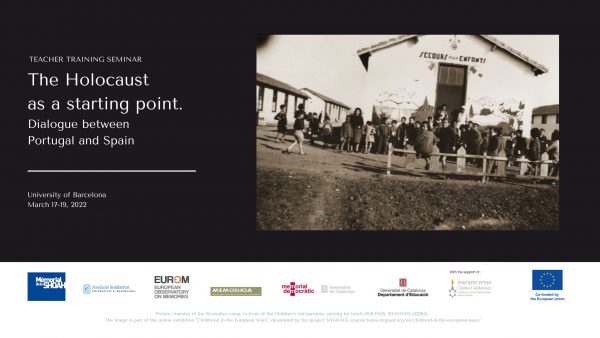
Reclusos del camp de Rivesaltes, davant de la caserna d’Ajuda a la Infància, esperant el dinar (1941-1942). ©USHMM (32285). La imatge forma part de l’exposició en línia “La infància a les guerres europees”, desenvolupada pel projecte MIGRAID.

Una quarantena de docents de secundària d’Espanya i Portugal es reuneixen, del 17 al 19 de març a la Facultat de Geografia i Història de la Universitat de Barcelona, per a la sisena edició del seminari de formació del professorat “L’Holocaust com a punt de partida”. L’organitzen el Mémorial de la Shoah i l’Observatori Europeu de Memòries (EUROM) de la Fundació Solidaritat UB, conjuntament amb Memoshoá, el Memorial Democràtic i el Departament d’Educació de la Generalitat de Catalunya; amb el suport de Claims Conference i la Comissió Europea.

El programa de tres dies es desenvolupa en castellà, portuguès i anglès, i consta de quatre conferències i cinc tallers amb l’objectiu de compartir continguts, eines i bones pràctiques, amb i entre els participants, sobre l’aproximació a l’Holocaust a l’aula.

El discurs d’obertura l’ha pronunciat, des de Kíev, Anatolii Podolskyi, director del Centre Ucraïnès d’Estudis de l’Holocaust. Tot seguit, s’ha ofert una conferència sobre la “Història de l’antijudaïsme“, a càrrec de Pierre Savy, de l’Ecole française de Rome, i s’ha presentat l’activitat d’aprenentatge 2021 “Republicans ibèrics en camps de concentració Mauthausen“.

La segona jornada del seminari inclou, al matí, la xerrada “Biopolítica del nazisme i el sistema soviètic“, per part de José Caselas (CFUL), i els tallers “Didàctica de l’Holocaust a través de la cartografia“, amb Jordi Barra (UB), i “Barcelona, el purgatori: els germans Sequerra entre l’infern i el paradís“, amb la professora/investigadora Maria João Duarte. A la tarda, s’abordarà la “Història de l’esclavisme a Espanya“, amb Gustau Nerín (UB), i s’oferiran els tallers “Treballar la història de l’esclavisme a l’aula“, amb Celeste Muñoz (UNED), i “La ficció narrativa i la representació del gran desastre humà”, amb el professor i escriptor João Pinto Coelho.

En la tercera jornada s’oferirà la conferència “Les etapes de la solució final“, amb Tal Bruttmann (EHESS), i es duran a terme els tallers “Eines per al treball amb els testimonis“, amb Noemí Riudor (UdL), i “Construir una activitat d’aprenentatge comú“, amb Loranda Miletić (ETTA). El seminari conclourà amb visites in situ per explorar la història i la memòria de la comunitat jueva als barris del Poble Sec (1920-1939) i el Gòtic (Edat Mitjana i actualitat).


Aquesta notícia té relació amb els següents ODS de l’Agenda 2030:

A seminar trains high school teachers on “The Holocaust as a starting point”

Aimed at forty teachers from Spain and Portugal, it will conclude with site visits to explore the history of the Jewish community in Barcelona.

Inmates of the Rivesaltes camp, in front of the Children’s Aid barracks, waiting for lunch (1941-1942). ©USHMM (32285). The image is part of the online exhibition “Childhood in the European Wars”, developed by the project MIGRAID.

Forty high school teachers from Portugal and Spain will gather, from 17 to 19 March at the Faculty of Geography and History of the University of Barcelona, for the sixth edition of the teacher training seminar “The Holocaust as a starting point”. It is organized by the Mémorial de la Shoah and the European Observatory on Memories (EUROM) of the Solidarity Foundation of the University of Barcelona, together with Memoshoá, the Memorial Democràtic and the Department of Education of the Generalitat de Catalunya; with the support of Claims Conference and the European Comission.

The three-day programme will be developed in Spanish, Portuguese and English, in four conference sessions and five workshops with the aim of sharing contents, tools and best practices, with and between the participants, on the approach to the Holocaust in the classroom.

The opening speech was delivered, from Kyiv, by Anatolii Podolskyi, director of the Ukrainian Center for Holocaust Studies. A lecture on the “History of Anti-Semitism” was given by Pierre Savy of the Ecole française in Rome, and the 2021 learning activity “Iberian Republicans in concentration camps Mauthausen” was presented.

The second day of the seminar includes, in the morning, the talk “Biopolitics of Nazism and the Soviet system“, by José Caselas (CFUL), and the workshops “Didactics of the Holocaust through cartography“, with Jordi Barra (UB), and “Barcelona, the Purgatory: the Sequerra brothers between Hell and Paradise“, with professor/researcher Maria João Duarte. In the afternoon, the “History of slavery in Spain” will be addressed, with Gustau Nerín (UB), and the workshops “Working on the history of slavery in the classroom“, with Celeste Muñoz (UNED), and “Narrative fiction and the representation of the great human disaster“, with professor and writer João Pinto Coelho, will be offered.

On the third day, the conference “The stages of the final solution” will be offered, with Tal Bruttmann (EHESS), and the workshops “Tools for working with witnesses“, with Noemí Riudor (UdL), and “Building up a common learning activity“, with Loranda Miletić (ETTA), will be held. The seminar will conclude with site visits to explore the history and memory of the Jewish community at the neighborhood of Poble Sec (1920-1939) and the Gothic Quarter (Middle Ages and nowadays).


This news is related to the following SDG of 2030 Agenda: